
Insertion Electromagnetic Flow Meter: An Option for Large-Diameter Pipelines

Introduction
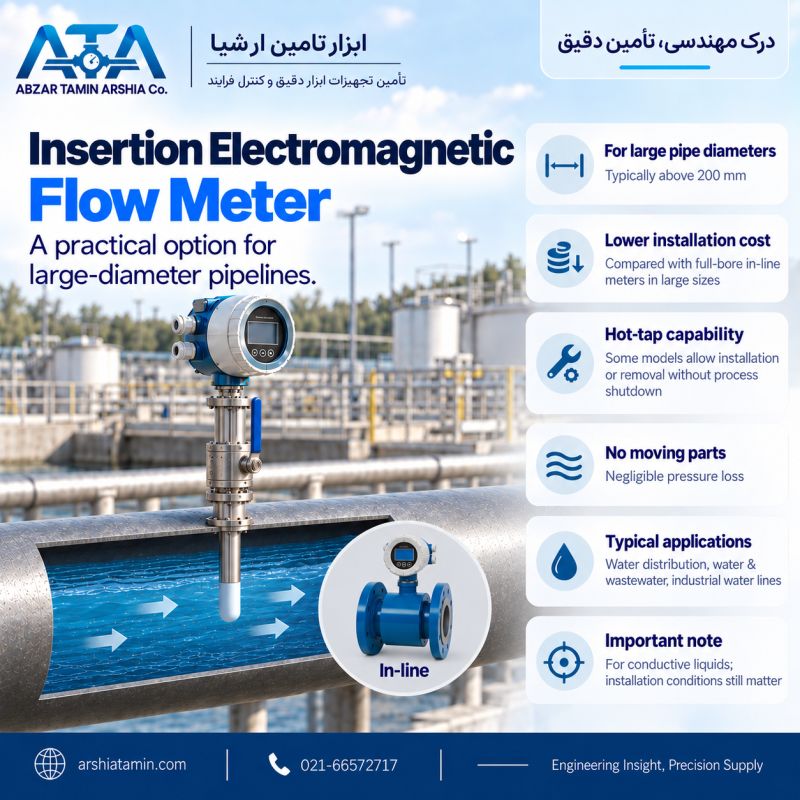
In various industries, measuring liquid flow rate is a key factor in controlling and optimizing processes. In water and other conductive liquid pipelines, especially large-diameter lines, using in-line electromagnetic flow meters can be challenging due to high installation and maintenance costs. In these cases, an insertion electromagnetic flow meter offers an economical and efficient alternative.
How an Insertion Electromagnetic Flow Meter Works
Insertion electromagnetic flow meters are designed so that their measuring probe is inserted into the pipe through a suitable connection. Using the principle of electromagnetic induction, the probe measures fluid velocity at the measuring point. The device then calculates the fluid’s volumetric flow rate based on the pipe specifications and velocity profile. This method allows users to measure flow without cutting or making major modifications to the pipeline.
Advantages of Insertion Electromagnetic Flow Meters
- Lower costs: One of the main advantages of insertion flow meters is reduced purchasing and installation costs. Instead of using a full-bore flow meter, only an insertion sensor is required.
- Easier installation: Installing this type of flow meter does not require cutting out and replacing an entire section of the pipeline. Some models also allow the sensor to be installed or removed under pressure.
- Versatile applications: Insertion electromagnetic flow meters are used in water transmission and distribution lines, cooling water systems, industrial facilities, and some process water lines.
Limitations of Insertion Electromagnetic Flow Meters
Despite their many advantages, insertion electromagnetic flow meters also have limitations that should be considered:
- Fluid electrical conductivity: The fluid must have sufficient electrical conductivity, and the pipe should normally be full at the measuring point.
- Installation location and depth selection: The probe’s installation location and depth, as well as the pipe’s internal diameter and velocity profile, have a significant effect on measurement accuracy.
- Accuracy depends on installation conditions: Measurement accuracy depends on installation and flow conditions. Insertion models should not be assumed to automatically deliver the same performance and accuracy as in-line models.
Conclusion
An insertion electromagnetic flow meter can be an economical and efficient option for measuring flow in large-diameter pipelines, particularly when the purchase and installation costs of full-bore flow meters are high. However, it is important to carefully assess the technical limitations and the process’s required accuracy. Paying close attention to installation details and fluid conditions is key to successfully using this type of flow meter.
Abzar Tamin Arshia (ATA) helps meet your industrial needs in this area by supplying insertion electromagnetic flow meters. Contact us for more information and consultation.
For more information about electromagnetic flow meters and flow meters, visit our website.
Consultation and Price Inquiry
To select the right equipment for your project or request a quotation, contact the Abzar Tamin Arshia experts through our price inquiry form.