
Why Isn’t Flow Meter Accuracy Enough for Precise Batching?

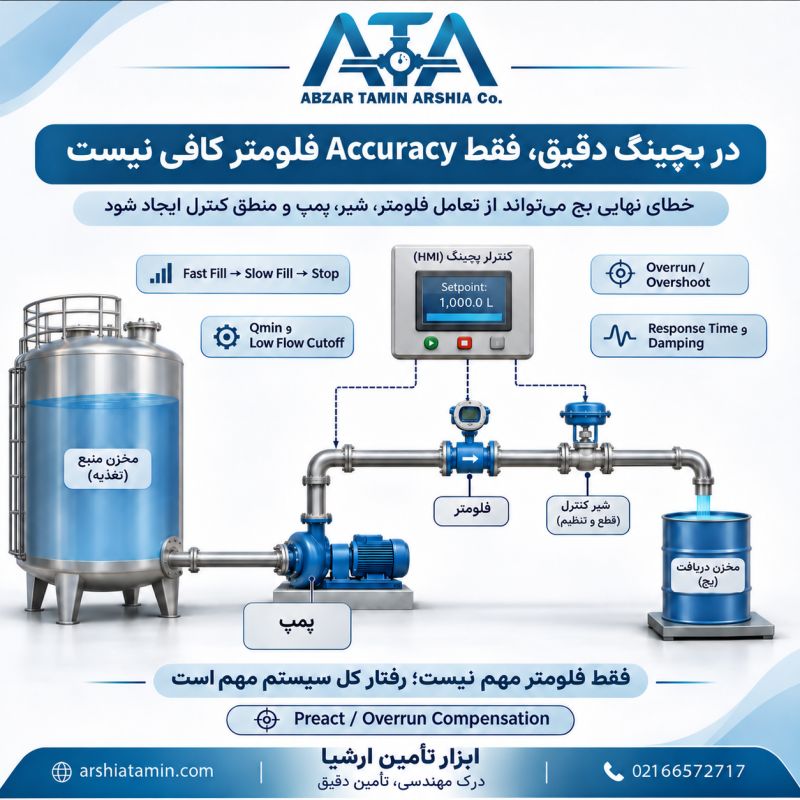
In batching and filling processes, the goal is to deliver a specified amount of fluid into a tank or container repeatably. In these applications, selecting a flow meter with suitable accuracy is essential; however, flow meter accuracy alone does not guarantee that the final amount in each batch will exactly match the setpoint. After a stop command is issued, fluid may continue to flow through the line, or the equipment may need time to reach a closed and stopped state.
For this reason, final accuracy depends on the performance of several pieces of equipment and settings: the flow meter, valve, pump, batch controller, and actual process conditions. Understanding these factors helps engineers and industrial buyers select a solution suited to the application and configure it based on the actual behavior of the line.
Why Is Flow Meter Accuracy Not Enough on Its Own?
A flow meter measures the flow passing through it and sends the information to the control system in a suitable form. However, a stop command does not usually mean that flow stops immediately. There may be a delay between the moment the controller issues the Stop command and the moment the flow actually decreases or stops. The valve closing time, pump operation, and fluid remaining in the line can all affect the final volume during this interval.
The amount that flows after a stop command is commonly referred to as Overrun or Overshoot. If the controller issues a stop command exactly when the measurement reaches the setpoint, the additional volume that continues to enter may increase the final batch amount. Therefore, system evaluation must account for the behavior of the entire process, not just the flow meter’s accuracy specification.
Other factors are also important. For example, changes in performance at low flow rates, the minimum measurable flow rate, response time, and signal damping can affect how soon the approach to the stop point is detected. As a result, performance that seems suitable under steady-flow conditions does not necessarily produce the same result during the final stage of a batch.
Low Flow, Qmin, and Signal Settings
In many filling applications, the flow rate decreases toward the end of the operation. The flow meter’s performance in this range must be compatible with its operating range and actual process conditions. Qmin refers to the minimum flow rate associated with usable flow meter performance. If the flow falls below the range in which the instrument can measure reliably, the controller may not have enough information to accurately determine the amount passing through.
Low Flow Cutoff should also be reviewed carefully. This setting can ignore flows below a specified threshold at the measurement output or treat them as zero flow. If some of the actual flow falls below this threshold during the final stage, the recorded amount may differ from the amount that passed through. An unsuitable setting for this feature can therefore affect the batching result.
In addition, Response Time and Damping affect how the signal changes and is transmitted. Excessive damping may delay the detection of flow changes, while a very fast response should also be evaluated in terms of signal stability and control logic. The appropriate setting depends on process behavior and control requirements; no single value is suitable for every line and application.
The Role of the Valve, Pump, and Batch Controller
The valve and pump are important components in the system’s actual response. The valve closing time, the way flow decreases, and the pump’s response to the control command can all change the amount that passes through after a stop command. During design or troubleshooting, it is important to determine how the control command reaches this equipment and how it actually behaves under the line’s operating conditions.
The Batch Controller receives measurement data and manages the process according to its configured logic. The flow meter’s pulse resolution and the way the controller processes pulses are also important, because the controller relies on the received signal to determine the amount that has passed through. Checking that the flow meter output is compatible with the controller input and confirming that the counting logic is configured correctly are both part of system evaluation.
To compensate for the additional amount at the end of a batch, the controller can issue a cutoff command before the measurement reaches the setpoint. This method is known as Preact or Overrun Compensation. Its purpose is to account for the expected volume that will pass through after the stop command is issued. The compensation value should be adjusted by observing the actual process performance, since valve, pump, and flow behavior can vary from one application to another.
Control Strategies for Reducing Batching Error
One common method is to divide the process into a fast-fill stage and a slow-fill stage: Fast Fill → Slow Fill → Stop. In the first stage, the flow moves toward the target at a higher rate. As the setpoint approaches, the controller switches to the slow-flow stage so that the final stop occurs at a lower flow rate. This method can provide better control of the final stage, but its design and configuration must be coordinated with equipment capacity and process behavior.
Another solution is to use Preact or Overrun compensation. This feature issues the stop command while accounting for the amount that will pass through afterward. Low Flow settings should also be checked to ensure that the signal required by the controller is not unnecessarily removed or distorted as the flow decreases. These methods do not replace proper equipment selection; rather, they are part of designing a coordinated system.
Considerations for Selecting and Installing a Batching System
When selecting a flow meter and controller, first define the process conditions and the application’s actual requirements. Fluid type, flow range and variation, filling method, pump and valve behavior, and the type of signal required by the controller all play a role in equipment selection and integration. The flow meter’s operating range must also be matched to flow conditions throughout every stage of the batch, especially near the stop point.
- Evaluate the full flow range: Consider not only the main flow rate but also the slow-fill flow and end-of-batch conditions.
- Check equipment compatibility: The flow meter output, Batch Controller input, and commands required by the valve and pump must be compatible.
- Consider installation: The installation location and piping arrangement should meet the equipment requirements and suit actual process conditions to prevent adverse effects on measurement and control.
- Test under operating conditions: Check stop performance, residual flow, and compensation settings during actual operation, and update the settings based on the observed results.
When selecting and installing equipment, it is best to consider process specifications, required capacity, and the control method as a complete system. Focusing on one piece of equipment without considering its relationship with the other components may prevent the system from achieving the expected performance.
Summary
In accurate batching, the final amount depends on the combined performance of the flow meter, valve, pump, and Batch Controller. Overrun after a Stop command, low-flow performance, Qmin, Low Flow Cutoff, Response Time, Damping, and pulse resolution can all affect the final result. Using Fast Fill and Slow Fill, configuring Preact appropriately, and reviewing Low Flow settings are possible ways to reduce error; however, their selection and configuration must match actual line conditions. Reviewing process specifications and required capacity is a suitable starting point for selecting a flow meter, Batch Controller, and appropriate control arrangement.
Consultation and Price Inquiry
To select the right equipment for your project or request a price quote, contact the Abzar Tamin Arshia team through the price inquiry form.