Pressure Snubber
- Effectively eliminates or dampens pulses, pressure shocks, and rapid pressure fluctuations in pipelines.
- Stabilizes pressure gauge readings, improving accuracy and readability.
- Significantly extends the service life of pressure sensors and measuring equipment.
- Fully passive operation with no need for calibration or maintenance.
- Available with various internal mechanisms (piston, orifice, porous disk) for gas and liquid media.
- Easy, direct installation with standard threaded connections.

Engineering-Led Selection

Genuine Products, Direct Sourcing
Phone:
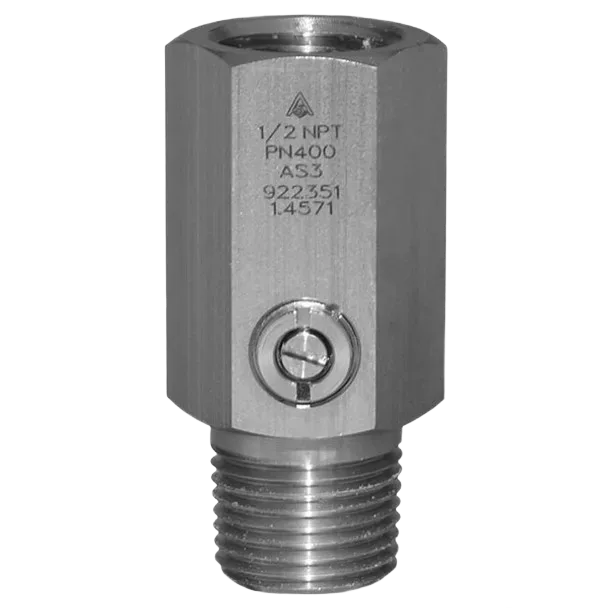
021-66572717A pressure dampener, or snubber, is a small, simple yet essential fitting installed between the process measurement point and a pressure measuring instrument, such as a gauge, transmitter, or switch.
The primary function of a snubber is to reduce or dampen pressure pulses, fluctuations, and sudden surges in the pipeline.
How it works: A snubber typically contains an internal flow-restricting element, such as a porous disc, a metal plug with a small orifice, or a chamber filled with liquid. By restricting the immediate flow of fluid to the instrument, this element slows the transmission of pressure changes and filters out transient pulses.
By filtering out pressure fluctuations, the pressure gauge pointer is protected from constant vibration, resulting in a much more stable and accurate pressure reading. More importantly, eliminating the effects of sudden pressure surges significantly helps extend the service life of the instrument’s internal components, such as the Bourdon tube mechanism or sensor diaphragm.
Snubbers are essential in piston pump lines, compressors, steam lines, and hydraulic systems, where pressure fluctuations are common.

| Measured Variable | Pressure |
|---|---|
| Fluid Type | Conductive Liquid, Gas, Non-Conductive Liquid, Steam |
| Installation Type | In-line |
| Process Connection | Thread |
| Wetted Part Material | Stainless Steel |
| Portability | Fixed |
| Measurement Technology | Pressure Accessories |
Submit Your Request in One Place
You can add multiple instruments to one request. The form shows the fields available for each product.
Frequently Asked Questions
It dampens fluctuations at the instrument by restricting rapid pressure transmission. This can stabilize the gauge needle reading and reduce mechanical wear.
Usually, static pressure is transmitted once equilibrium is reached. A snubber is not a pressure regulator and is not designed to limit pressure continuously.
No. It can dampen some pressure pulses, but it is not a substitute for overpressure protection. The gauge’s pressure rating and shock specifications should be checked separately.
It is selected based on the intensity and frequency of pressure fluctuations, the fluid type, and the desired response time. Excessive damping can delay the indication of important pressure changes.
A narrow passage or porous element may become blocked. The snubber type, passage size, and cleaning requirements should be compatible with the fluid’s cleanliness and viscosity.
Closing the passage can isolate the pressure indication from the process. Adjust it according to the instructions and the instrument’s response requirements.
Specify the fluid type, viscosity and particulates, pressure and temperature, type of fluctuation, thread, material, and required response time of the gauge or transmitter.