
How to Choose a Flow Meter for High-Viscosity Liquids

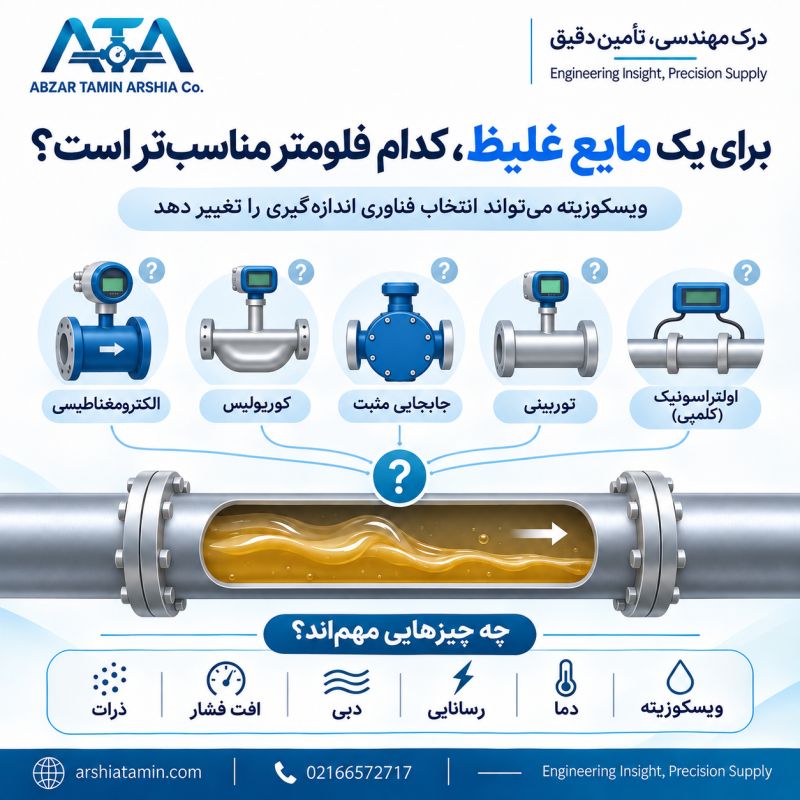
Selecting a flow meter for high-viscosity liquids cannot be done based only on pipe size and required flow rate. Viscosity affects how fluid moves through the pipe, pressure drop, measurement range, and the performance of some measurement technologies. As a result, a flow meter that performs well with a low-viscosity liquid may not be the right choice for a thick or sticky fluid.
Before selecting a meter, it is important to understand the actual process conditions: viscosity at operating temperature, temperature and pressure variations, fluid cleanliness, minimum and maximum flow rates, required output type, and acceptable pressure drop. Below, we review the key considerations and several common technologies to help clarify the selection process.
How Does Viscosity Affect Flow Measurement?
Viscosity is a measure of a fluid’s resistance to flow. The higher the viscosity, the more difficult it may be for the fluid to move through the pipe and the internal components of the flow meter. This can result in increased pressure drop, changes in the flow profile, or a reduced measurable flow range. The extent of this effect depends on the flow meter technology, internal design, installation conditions, and the properties of the fluid itself.
The viscosity of many liquids changes with temperature. Therefore, fluid specifications at ambient temperature do not necessarily represent conditions in the process line. If the temperature varies during operation, viscosity may also change, and measurement performance may differ across flow rates. In applications involving temperature control, heating, or cooling, the actual operating temperature range should be considered when evaluating a flow meter.
It is also important to distinguish between volumetric and mass flow measurement. The choice depends on the process requirements; for example, volume-based control may be needed, or production and consumption calculations may require the fluid’s mass. Defining this requirement early narrows down the options and helps make the selection more precise.
Which Technologies Can Be Considered?
Positive Displacement Flow Meters
Positive displacement flow meters trap and count fixed volumes of fluid within the measuring section. This method may be worth considering for some viscous liquids, particularly when volumetric measurement is important. However, moving parts, material compatibility with the fluid, liquid cleanliness, and the possibility of particles entering the meter must be assessed. Solid particles or contamination can affect component movement and equipment life. The meter’s internal resistance and pressure drop should also be checked against process limitations.
Coriolis Flow Meters
Coriolis flow meters are used for direct mass flow measurement and may be considered for some viscous liquid applications. However, suitability cannot be determined based solely on the technology name. Equipment design, fluid properties, required flow rate, and allowable pressure drop are all important. When selecting a meter, ask the manufacturer or supplier for information about its performance under actual process conditions and its compatibility with the fluid in question.
Electromagnetic Flow Meters and Other Technologies
Electromagnetic flow meters may be considered for conductive liquids, so fluid conductivity is one of the first points to check when selecting one. This technology is generally not suitable for non-conductive liquids. For other technologies, measurement limitations at low flow rates, changes in viscosity, and pressure drop should also be assessed. For example, methods that depend on flow behavior or specific fluid conditions may require closer evaluation within certain flow rate or viscosity ranges. Therefore, a general ranking of technologies is not reliable without application-specific details.
Information to Gather Before Selection
To compare options effectively, provide as much information as possible about the fluid and process. Viscosity should be stated along with the temperature at which it was measured; a value without a temperature may not accurately represent actual conditions. If viscosity changes across the process temperature range, provide those variations as well. Operating pressure and temperature, the fluid’s composition or properties, the presence of solid particles, and the possibility of changes in composition are also important.
- Flow conditions: Specify the actual minimum, normal, and maximum flow rates, and clarify whether continuous or intermittent measurement is required.
- Fluid properties: Consider conductivity, cleanliness, potential corrosiveness, and the presence of particles or bubbles.
- Measurement requirements: Determine whether the required output is volumetric or mass flow, and whether the measurement data will be used for indication, recording, or process control.
- Pipeline limitations: Specify the pipe size and configuration, available pressure, and allowable pressure drop.
- Operating conditions: Provide the selector with information about temperature and pressure variations, shutdowns and startups, and possible flow fluctuations.
This information helps ensure that options are compared based on actual conditions, rather than only on connection diameter or nominal flow range. If data is unavailable, measuring or engineering-estimating it before purchase can help prevent an unsuitable selection.
Installation and Commissioning Considerations
Even a suitable flow meter may not provide reliable measurements if installed incorrectly. The installation location must comply with the instructions for the specific device and the pipeline configuration. Keeping the measuring section full of fluid, observing the installation orientation, properly supporting the pipe, and avoiding mechanical stress on the connections are all points to check. In viscous applications, it is also important to consider areas where fluid may stagnate or where draining and filling the line may be difficult.
Before commissioning, check the line for cleanliness and the possibility of particles or process residue. Installing a strainer may be worth considering in some applications to protect the equipment, but its selection and placement should account for the risk of blockage and pressure drop. Actual temperature and flow rate conditions during startup should also be checked against the selected operating range. For each technology, the manufacturer’s instructions for installation, commissioning, and maintenance are the primary reference.
Summary
There is no single answer that applies to every high-viscosity liquid application. Viscosity at the actual operating temperature, fluid conductivity and cleanliness, minimum and maximum flow rates, the need for volumetric or mass measurement, and allowable pressure drop must all be considered together. Technologies such as positive displacement, Coriolis, and electromagnetic flow measurement may be considered under different conditions, but the suitability of each depends on the process specifications.
To evaluate the options, prepare the fluid type, viscosity and its associated temperature, pressure, flow range, and pipe size. Abzar Tamin Arshia can review the options suitable for your application based on this information.
Consultation and Price Inquiry
To select the right equipment for your project or request a quote, contact the Abzar Tamin Arshia team through the Price Inquiry Form.