
What Is Flow Meter Repeatability and Why Does It Matter?

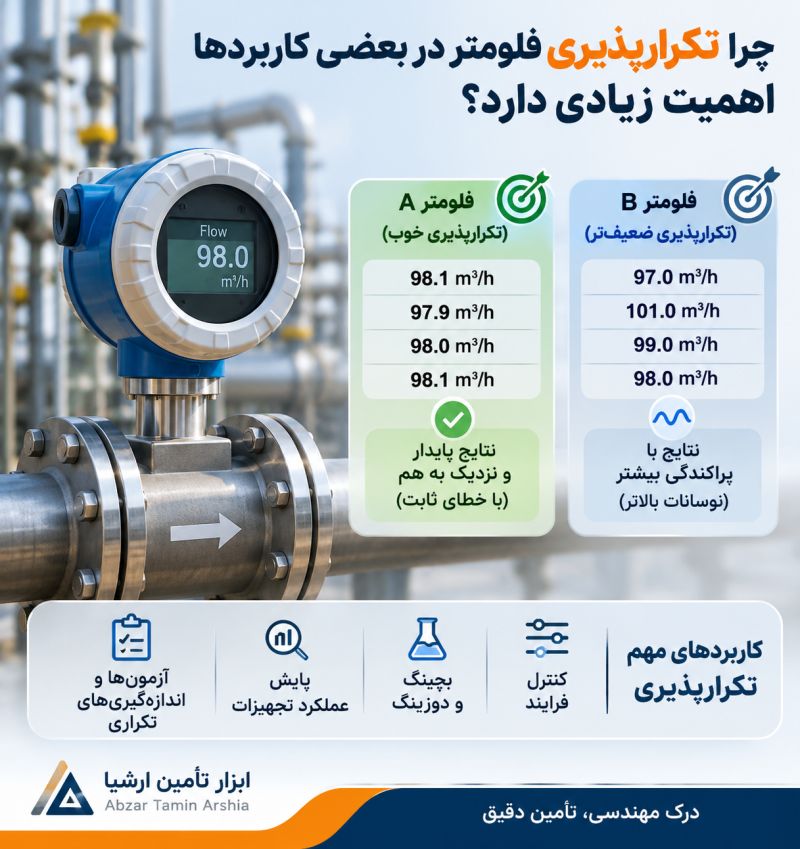
When selecting a flow meter, measurement accuracy is usually one of the first specifications to consider. This parameter indicates how close the instrument’s reading is to the actual value. However, in many industrial applications, it is also important to know whether the flow meter can provide stable results close to previous readings under similar conditions. This characteristic is called repeatability.
Good repeatability alone does not mean that measurements are necessarily close to the actual value, just as good accuracy does not necessarily guarantee low variation between consecutive readings. Understanding the difference between these two concepts helps you select a flow meter based on the actual measurement objective and process requirements.
What Does Flow Meter Repeatability Mean?
Repeatability indicates how consistently a measuring instrument produces similar results over successive measurements when measurement conditions remain as similar as possible. For a flow meter, this characteristic relates to the stability of flow rate readings under similar process conditions—for example, when the fluid conditions and pipeline state have not changed significantly.
Suppose the actual flow rate in a line is nearly constant at 100 cubic meters per hour. In several consecutive measurements, one flow meter might consistently show a value close to 98 cubic meters per hour. Another flow meter, under the same conditions, might show 97, then 101, and then 99 cubic meters per hour. In the first case, the readings are close to one another, but a systematic error may be present. In the second case, some readings are closer to the actual value, but the results vary more.
This example shows that evaluating flow meter performance requires considering both how close the readings are to the actual value and how stable the results are. Repeatability is not a substitute for evaluating accuracy; rather, it provides complementary information about how the instrument performs across repeated measurements.
Difference Between Repeatability and Measurement Accuracy
Accuracy refers to how close a measurement result is to the actual or reference value. Repeatability, by contrast, indicates how close the results of measurements taken under similar conditions are to one another. Simply put, accuracy concerns closeness to the reference value, while repeatability concerns the consistency of results across multiple measurements.
A flow meter may therefore provide very similar readings, while all of them differ from the actual value. This behavior may be consistent, but the cause of the discrepancy must be investigated to obtain a correct measurement. Conversely, the average of several readings may be close to the reference value, even though the readings themselves vary considerably. In this situation, relying on a single reading can be difficult.
When reviewing technical specifications, consider these two characteristics separately and assess them in relation to the application. If the objective is to measure the actual value with the least possible deviation, accuracy is especially important. If decisions depend on comparing successive readings or repeating an operation, repeatability should also be carefully evaluated.
In Which Applications Is Repeatability More Important?
- Process control: A controller uses signals received from instruments to decide whether to change or maintain process conditions. If a flow meter’s output fluctuates without cause under stable conditions, the controller may respond to changes that are not due to an actual change in flow rate. As a result, measurement stability can support more reliable decision-making.
- Batching and dosing: In processes where fluid quantities are measured or injected in separate cycles, obtaining similar results in each cycle is important. Good repeatability helps compare cycle performance and makes process changes easier to detect. However, the final result depends on more than the flow meter; the conditions of the entire system also have an effect.
- Equipment performance monitoring: Detecting gradual changes in pipeline or equipment performance requires distinguishing actual changes from instrument fluctuations. If the flow meter itself produces unstable readings, detecting a small change in flow becomes more difficult.
- Repeated tests and measurements: In tests where measurements are taken on multiple occasions, consistent results make comparisons more meaningful. In these situations, good repeatability can make it easier to assess observed changes.
Flow Meter Selection and Installation Considerations
Begin by defining the measurement objective when selecting a flow meter: Is the main requirement for readings to be close to the actual value, for results to be repeatable across similar cycles, or for changes in flow rate to be detected over time? The answer determines which specifications should be prioritized. In any case, comparing flow meters based on a single value or characteristic does not provide a complete picture of their suitability for an application.
Also consider process conditions during selection. The fluid type, flow conditions, expected operating range, and how the measurement output will be used are all important when evaluating options. Match the instrument’s published specifications to actual application conditions, and obtain sufficient information about its measurement method, limitations, and maintenance requirements.
Correct installation is also essential for stable performance. Select the installation location and pipeline configuration in accordance with the manufacturer’s instructions, and avoid conditions that could adversely affect the flow at the measurement point. Also check the connections, installation orientation, and commissioning procedure. Since installation requirements vary between flow meter types, a single set of instructions should not be applied to all equipment; use the guide for the specific model and assess its suitability for the pipeline conditions.
After installation, check the flow meter’s performance under stable conditions and compare readings across repeated measurements. If the output fluctuates, before concluding that the instrument is faulty, also check for actual process changes, installation conditions, and the state of the measurement system. Periodic evaluation and maintenance of the instrument according to application requirements help maintain measurement quality.
Summary
Repeatability indicates how consistently a flow meter can provide similar results under similar conditions, while accuracy describes how close a measurement is to the actual value. These two specifications complement each other, and the importance of each depends on the measurement objective. In process control, dosing, equipment monitoring, and repeated testing, reading stability can play an important role in decision-making. Therefore, when selecting a flow meter, consider not only accuracy but also repeatability and the instrument’s suitability for the process and installation conditions. To select the right option, provide the application details and pipeline conditions to the instrument specialists at Abzar Tamin Arshia.
Consultation and Price Inquiry
To select the right equipment for your project or request a price quotation, contact the specialists at Abzar Tamin Arshia through the price inquiry form.