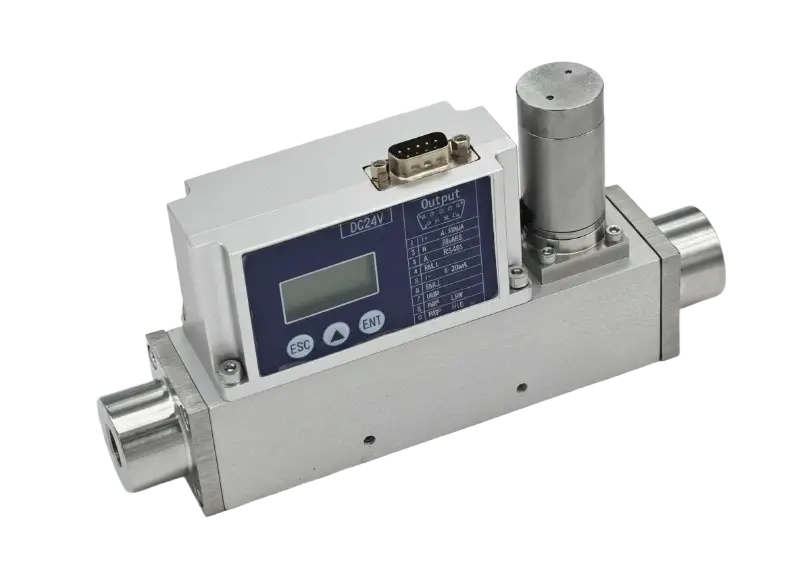

Gas Mass Flow Controller MFC
- Direct measurement and control of gas mass flow.
- Equipped with an internal control valve for stabilizing and automatically adjusting the flow rate to the setpoint.
- Excellent accuracy and repeatability in flow control, even at very low flow rates.
- Fast response for rapid flow adjustment.
- The gas type, operating pressure, and temperature must match the model’s calibration range.

Engineering-Led Selection

Genuine Products, Direct Sourcing
Phone:
021-66572717A thermal mass flow controller (MFC) is an advanced device that not only accurately measures the mass flow rate of gases, but also adjusts and controls it.
The device works by transferring heat from a heating element to the gas flow. This enables the MFC to directly calculate the mass flow rate and measure gas mass flow within its specified calibration range.
The main difference between a controller and a thermal flow meter is the controller’s built-in fast, precise control valve. An operator or control system (PLC) can send a reference mass flow rate (Set Point) to the device. The MFC’s control unit then compares the measured flow rate with the reference value and continuously adjusts the control valve position to keep the gas outlet flow rate precisely at the desired value. This capability is highly useful in sensitive, automated processes such as semiconductor equipment, precise gas mixing, chemical reactor systems, and gas chromatography instruments.
- PDF Datasheet EN 762 KB Download
Introduction to Low-Flow Mass Flow Meters
Submit Your Request in One Place
You can add multiple instruments to one request. The form shows the fields available for each product.
Frequently Asked Questions
In addition to measuring flow, an MFC has a control valve and control circuit. It compares the flow rate with the setpoint and regulates it within its operating range.
Depending on the model, an analog signal, digital communication, or local control is used. The command type and its scale must be compatible with the PLC or controller.
No. The valve requires sufficient differential pressure to control flow. The inlet pressure, outlet pressure, and valve capacity must be suitable for the requested flow rate.
No. The gas type and compatible materials must be specified. Changing the gas may require manufacturer-approved settings or recalibration.
This should not be assumed without checking the manufacturer’s specifications. Allowable leakage and de-energized behavior must be verified; a separate valve may be required for fail-safe shutoff.
Fluctuating supply pressure, restrictions in the outlet line, an unsuitable range selection, and control settings are possible causes. Troubleshooting should start with the actual inlet and outlet conditions.
Specify the gas, minimum and maximum flow rates, inlet and outlet pressures, temperature, command and output signals, materials and connections, and the desired valve position when power is lost.