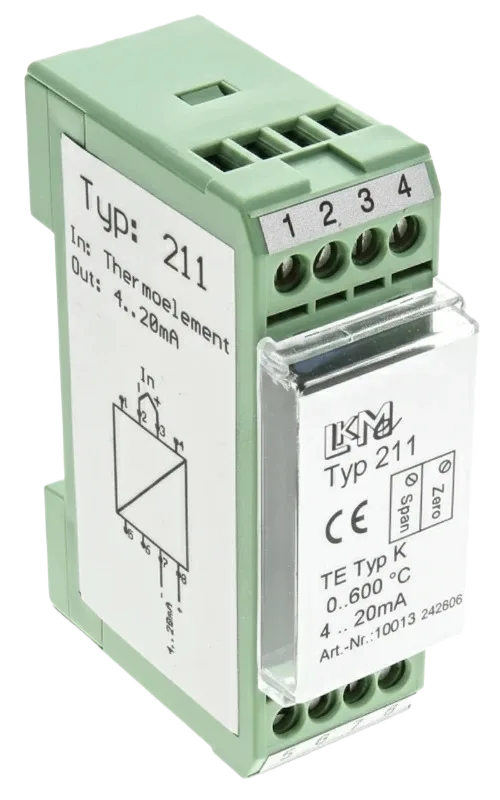
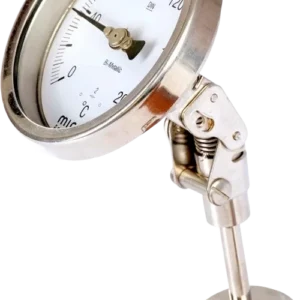
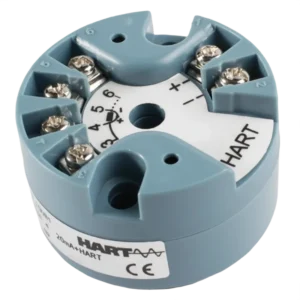
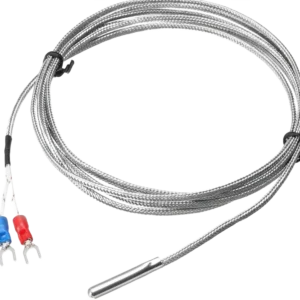
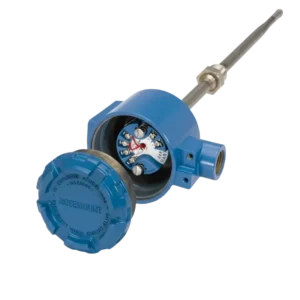
Rail-Mount Temperature Transmitter
- Designed for quick and easy installation on DIN rails in control panels.
- Converts sensor signals (RTD/TC) into a highly stable 4 to 20 mA output.
- Ideal for centralizing wiring and managing temperature signals in the control room.
- Features galvanic isolation to eliminate noise and protect the PLC.
- Allows precise span adjustment and easy calibration.
- Suitable for large control systems with numerous analog inputs.

Engineering-Led Selection

Genuine Products, Direct Sourcing
Phone:
021-66572717A rail-mount temperature transmitter is a box-shaped electronic instrument specifically designed for installation on DIN rails in industrial control panels. Its primary function is to receive the input signal from RTD or thermocouple temperature sensors installed at the process location and convert it into a standard industrial signal (4 to 20 mA) for connection to a PLC or DCS.
The key difference between this model and a head-mount transmitter is its installation location: instead of being installed in the sensor head at the process, it is mounted in the controlled environment inside the panel. This allows all wiring from different sensors to be consolidated at a single point—the control panel.
These transmitters typically offer precise configuration and calibration, and many provide advanced features such as Galvanic Isolation to protect control equipment from noise and ground potential differences (Ground Loop).
Rail-mount transmitters are an ideal choice for large control systems and processes that require centralized maintenance and troubleshooting in the control room.

| Measured Variable | Temperature |
|---|---|
| Measurement Technology | RTD, Thermocouple |
| Display Type | Without Display |
| Accuracy Class | ±0.25%, ±0.5% |
| Output Signal | 4-20 mA |
| Power Supply | 24V DC, Loop Powered |
| Portability | Fixed |
| Certification | General Purpose |
| Installation Type | Rail Mount |
Submit Your Request in One Place
You can add multiple instruments to one request. The form shows the fields available for each product.
Frequently Asked Questions
A rail-mount transmitter is installed on a DIN rail inside a panel, while a head-mount transmitter is installed in the sensor head. The distance the sensor wiring must run to the conversion point is an important factor in selecting a transmitter.
No. The RTD or thermocouple wiring run to the panel is still susceptible to errors. The cable type, number of wires, compensation, and noise protection must be appropriate for the sensor.
The transmitter must support a 3-wire connection and the required element type. Wire resistance and symmetry, as well as correct input configuration, affect error compensation.
In models with isolation, separating the circuits can reduce the effects of potential differences and ground loops. Check the datasheet for the isolation level and isolation path.
The output and power supply type depend on the model. Specify the current or voltage output, whether the loop is active or passive, and compatibility with the control card.
The number of channels, installation space, ventilation, and separation of signal and power wiring are important. Ambient temperature limits and power supply load must also be observed.
Please provide the sensor type and quantity, wiring, range, number of channels, output, power supply, isolation requirements, and conditions inside the panel.