Head-Mount Temperature Transmitter
- Converts the weak sensor signal (RTD/TC) into a noise-resistant 4 to 20 mA output.
- Eliminates the effects of electrical noise during long-distance data transmission to the control room.
- Reduces wiring costs by eliminating the need for expensive compensating or multi-core cables.
- Programmability for configuring the range and sensor type (Multi-Input).
- Easy, direct installation in the temperature sensor’s protective head.
- Improves the overall accuracy and stability of the temperature measurement system.

Engineering-Led Selection

Genuine Products, Direct Sourcing
Phone:
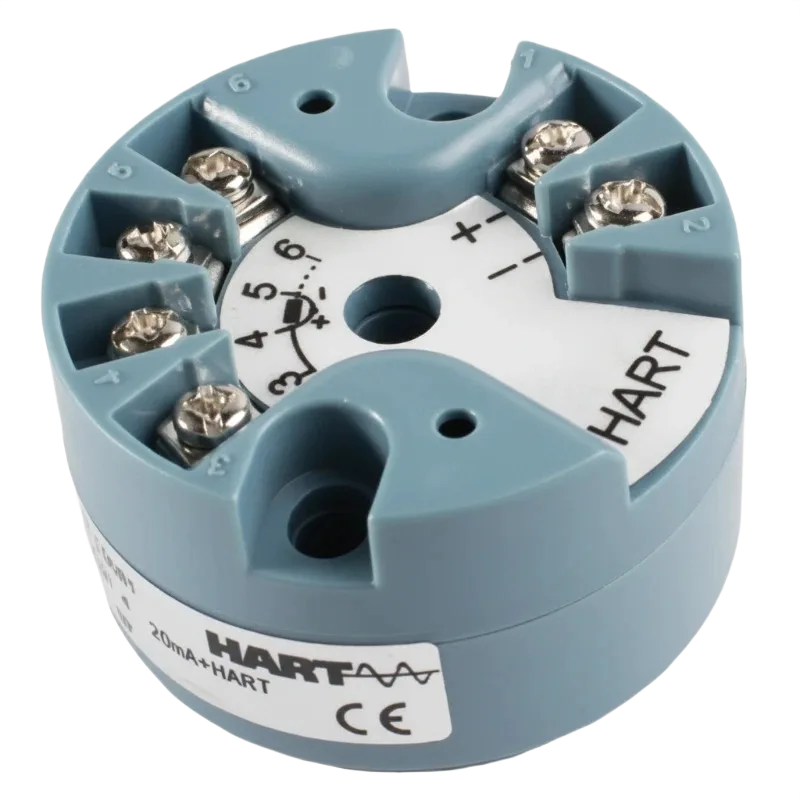
021-66572717A headmount temperature transmitter is a small, compact electronic converter designed to be installed in the head or connection housing of RTD or thermocouple temperature sensors. Its primary function is to convert the sensor’s weak, sensitive signal (resistance or millivolts) into a standard industrial signal (typically 4 to 20 milliamps) that is resistant to noise.
Operating principle: The device receives the input signal from an RTD or thermocouple sensor and uses intelligent electronic circuits to linearize and amplify it. The standard 4 to 20 milliamp output is then sent through ordinary copper wires to a display or control system (PLC/DCS).
Using headmount transmitters is very important. First, it reduces the effects of electrical noise during signal transmission over long distances. Second, it reduces the need for thermocouple extension cable or multi-wire RTD connections along the route from the transmitter output to the control room. The connection between the sensor and the transmitter input must still match the sensor type. Third, it provides rangeability adjustment for the sensor.
These devices are available in standard and programmable versions.

| Measured Variable | Temperature |
|---|---|
| Measurement Technology | RTD, Thermocouple |
| Display Type | Without Display |
| Accuracy Class | ±0.25%, ±0.5% |
| Output Signal | 4-20 mA, HART |
| Power Supply | 24V DC, Loop Powered |
| Portability | Fixed |
| Certification | Ex-proof, General Purpose |
| Installation Type | Head Mount |
Submit Your Request in One Place
You can add multiple instruments to one request. The form shows the fields available for each product.
Frequently Asked Questions
It is installed in the sensor head and converts a resistance or millivolt signal into an industrial output. Converting the signal close to the sensor makes it easier to transmit to the control system.
No. Input types and programmability depend on the model. Confirm the RTD type, number of wires, or thermocouple type before ordering.
No. The input and output range must be configured for the new sensor. For thermocouples, the cold-junction compensation type must also be set correctly.
Yes. The temperature inside the head must remain within the transmitter’s ambient temperature limits. Neck length, insulation, and heat transfer from the process all affect the installation design.
It usually requires an external RTD or thermocouple sensor. The input type must be compatible with the sensor and readout circuit.
Models with fault diagnostics can indicate an open circuit or certain input faults. The fault current behavior and PLC logic should be checked and configured.
Specify the sensor type, number of wires, temperature range, output, loop power supply, head dimensions, isolation, and protection requirements.