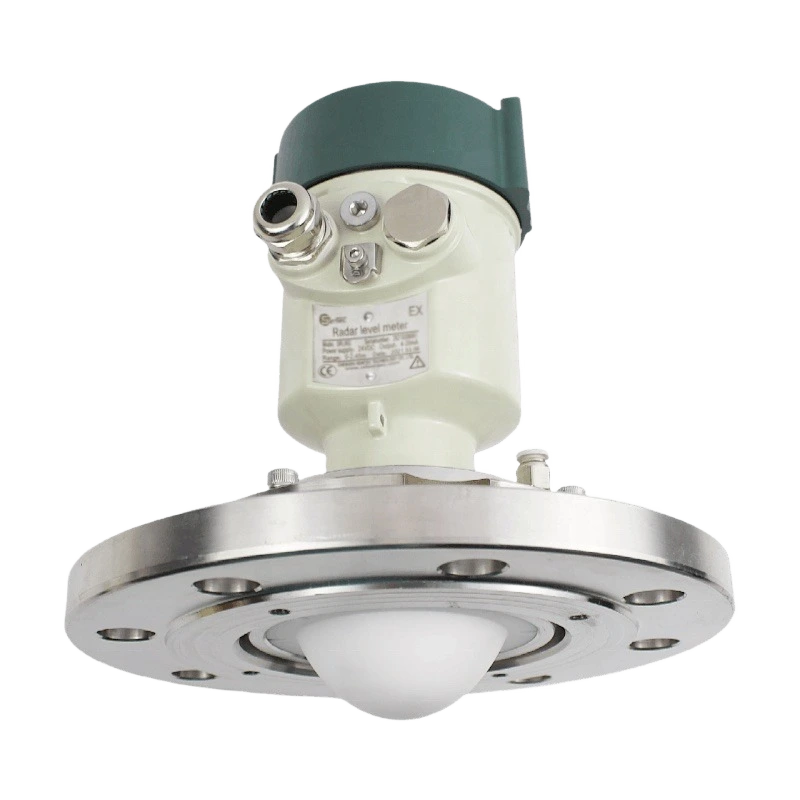
Non-Contact Radar Level Transmitter

  • Completely non-contact level measurement with high accuracy and repeatability.
  • Unaffected by changes in the temperature, pressure, or density of gases inside the tank.
  • Ideal for applications in pressurized, vacuum, and high-temperature tanks.
  • Performs well in environments with turbulent liquids.
  • Measures liquid levels and bulk solids over long distances.
  • Available with a range of horn and lens antennas suited to corrosive and contaminated environments.

Engineering-Led Selection

Genuine Products, Direct Sourcing

×

Phone:

021-66572717
Product Overview

A non-contact radar level transmitter (Free Space Radar) is a highly accurate, advanced measuring instrument that measures the level of liquids, pastes, and bulk solids without physical contact with the process material.

Operating principle: The device transmits high-frequency electromagnetic pulses (radio waves) vertically toward the process material’s surface through its antenna, which is usually horn-shaped or lens-based. The waves strike the surface and are reflected back toward the antenna. The transmitter measures the waves’ round-trip time (Time of Flight – TOF) and, based on the speed of light, calculates the distance between the sensor and the liquid surface with very high accuracy. The liquid level is then determined using internal calculations.

A key advantage of non-contact radar is that it is less sensitive than ultrasonic technology to many changes in process conditions. Unlike ultrasonic waves, electromagnetic waves are generally less affected by changes in the gas above the surface; however, dense vapor, extreme process conditions, and dielectric constant must be evaluated against the model specifications. This makes non-contact radar ideal for measurement in pressurized or vacuum tanks, or at very high temperatures, such as in applications involving fuels, chemicals, and petroleum products. Newer generations with higher frequencies, such as 80 GHz, offer a narrower beam and better performance in the presence of internal obstructions or surface turbulence.

Key Features
Measured Variable
Measurement Technology
Fluid Type
Installation Type
Display Type
Output Signal
Power Supply
Process Connection
Certification
Request a Quote
Technical & Commercial RFQ

Submit Your Request in One Place

You can add multiple instruments to one request. The form shows the fields available for each product.

ATA SMART RFQ Engineering Insight, Precision Supply
۱

Contact Information

We will send the quotation response to this contact.

۲

Select and Add a Product

Search for a product or select one from the list to add its form.

Standard specifications will be listed in the quotation. You can request changes after receiving it.

۳

Attachments and Notes

Attach at least one file when choosing Upload RFQ Files Only.

Choose FilesPDF, Word, Excel, image, DWG or DXF — up to 10 MB per file
    ۰ قلم تجهیزAll items and files will share one tracking number.

    Frequently Asked Questions

    Radar uses electromagnetic waves, while ultrasonic instruments use sound waves. Their sensitivity to conditions inside the tank differs, so the right choice depends on the application.

    No. Dielectric constant, surface reflectivity, dust, and tank geometry must be considered. The model’s antenna and frequency must be compatible with the material and installation conditions.

    Yes. They can affect the strength and quality of the reflected signal. Foam type and the risk of antenna buildup should be considered during selection and maintenance planning.

    An unsuitable nozzle, tank walls, and internal equipment can create unwanted reflections. The beam angle and antenna location must be matched to the tank geometry.

    It may be suitable if the model’s process connection and pressure rating are appropriate. The pressure, temperature, antenna material, and sealing must meet the tank’s design conditions.

    The primary measurement is level or distance. Volume also depends on tank geometry, while mass depends on density; both require suitable calculations or configuration.

    Please provide the material and approximate dielectric constant, tank height, nozzle and internal obstructions, pressure and temperature, foam or dust conditions, process connection, output, and required protection certification.