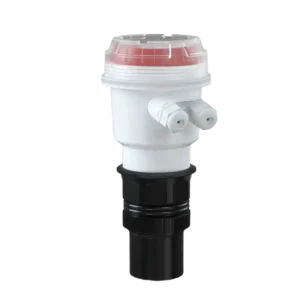
Magnetostrictive Level Transmitter
- High accuracy.
- Float position measurement independent of the dielectric constant, with a suitable float selected for the fluid density and operating pressure.
- Stable, repeatable measurement due to the physical nature of the magnetostrictive effect.
- Ability to simultaneously measure the level and the interface level between two liquids.
- Rugged design for use in fuel, oil, and chemical tanks.
- Standard 4 to 20 mA signal output with support for smart protocols.

Engineering-Led Selection

Genuine Products, Direct Sourcing
Phone:
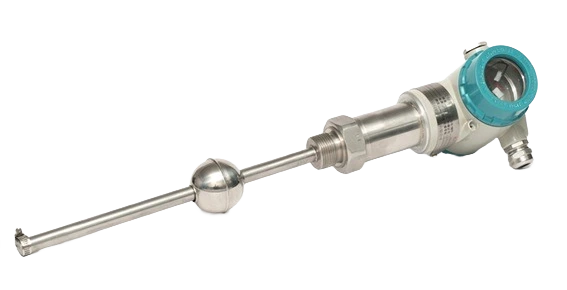
021-66572717A magnetostrictive level transmitter is a contact level measurement instrument designed to determine liquid levels with very high accuracy and excellent resolution. It typically consists of a probe or waveguide rod and a magnetic float that moves freely along the probe.
Operating principle: The probe is installed inside the tank, and the magnetic float floats on the liquid surface. The transmitter sends an electrical current pulse along the waveguide rod. This pulse generates a momentary magnetic field around the rod. When this magnetic field interacts with the float’s strong magnetic field, a mechanical effect known as the magnetostrictive effect occurs, generating a torsional wave in the rod. This torsional wave travels back to the end of the probe at the speed of sound and is detected by the sensor. By measuring the wave’s time of flight, the precise distance between the float and the top of the probe—and therefore the liquid level—is calculated. This method provides highly stable measurements that are independent of the dielectric constant; the float selection and its immersion depth must be compatible with the liquid’s density.
Thanks to its very high accuracy, this technology is ideal for applications involving product custody transfer, fuel level measurement at gas stations, and any application requiring precise monitoring of liquid volume.

| Measured Variable | Level |
|---|---|
| Fluid Type | Conductive Liquid, Non-Conductive Liquid |
| Installation Type | Contact |
| Accuracy Class | ±0.1%, ±0.25% |
| Display Type | Digital, With Display, Without Display |
| Output Signal | 4-20 mA, HART |
| Power Supply | 24V DC, Loop Powered |
| Process Connection | Flange, Thread |
| Wetted Part Material | Stainless Steel |
Submit Your Request in One Place
You can add multiple instruments to one request. The form shows the fields available for each product.
Frequently Asked Questions
The magnetic float moves along the liquid surface. The time taken for the resulting torsional wave to travel through the waveguide determines the float position and, consequently, the liquid level.
The float must be designed to operate in the liquid. A density below the permitted limit or significant changes in density can affect buoyancy and readings.
The float must move freely; sediment, sticky substances, or solids can cause it to stick. Application compatibility should be confirmed before selection.
Interface measurement may be possible with a model fitted with a suitable float. The densities of both phases, the difference between them, and the float design must be suitable for the application.
Probe alignment, unrestricted float movement, measurement length, and mechanical conditions are important. Output resolution alone does not guarantee the accuracy of the complete installation.
Check probe cleanliness, unrestricted float movement, seal integrity, and component compatibility. The assembly must be isolated and handled using safe procedures before disassembly.
Please provide the liquid type and density, viscosity, measurement height, interface measurement requirements, pressure and temperature, probe and float materials, connection, and output.