
Engineering-Led Selection

Genuine Products, Direct Sourcing
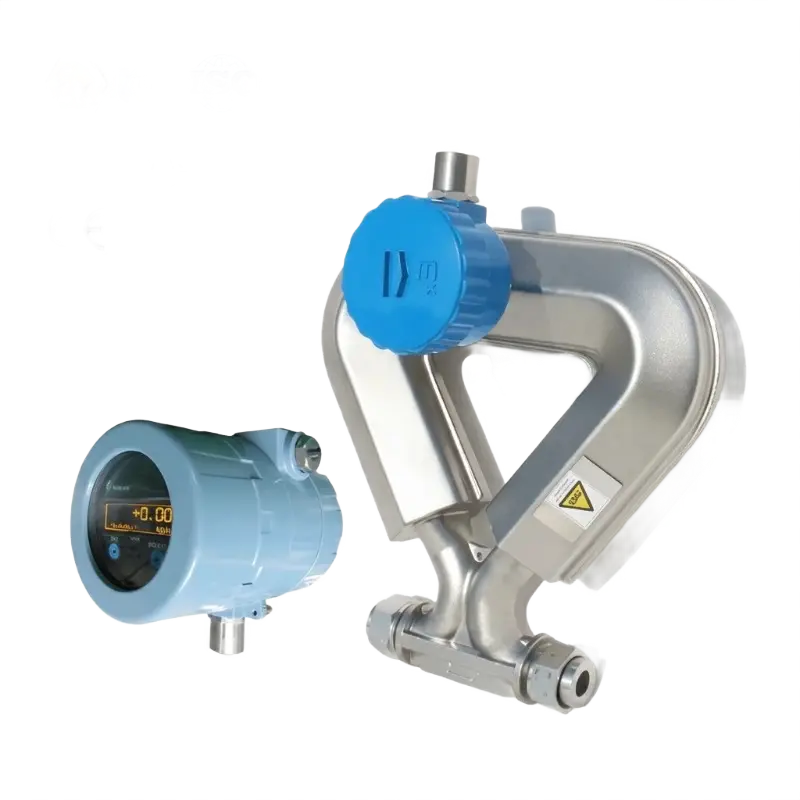
A Coriolis flow meter is a true mass flow meter (True Mass Flow Meter) capable of directly measuring mass flow (Mass Flow), fluid density (Density), and temperature (Temperature) in a single device.
This flow meter operates on the Coriolis force principle. It consists of one or more curved or straight measuring tubes that are vibrated at their natural frequency by a driver (Driver). As the fluid (liquid or gas) flows through these vibrating tubes, its acceleration and deceleration during the vibration cycle cause a change in the tubes’ vibration waveform (twist or torque), which is directly proportional to the mass flow rate. This twist is measured by magnetic sensors, creating a phase shift (Phase Shift) between the inlet and outlet sensors.
This technology directly measures mass flow and does not depend on the fluid’s electrical conductivity; the final accuracy depends on the model, installation conditions, and fluid condition.
Thanks to their ability to measure multiple variables, these flow meters are used in sensitive industries such as Custody Transfer, food, pharmaceutical, and chemical industries, where precise control of mass and concentration is required.
| Measured Variable | Flow |
|---|---|
| Measurement Technology | Coriolis |
| Fluid Type | Conductive Liquid, Gas, Non-Conductive Liquid, Slurry |
| Installation Type | In-line |
| Accuracy Class | ±0.1% |
| Output Signal | 4-20 mA, HART, Pulse, RS485 |
| Process Connection | Flange, Thread |
| Wetted Part Material | Stainless Steel |
| Display Type | Digital, With Display, Without Display |

Submit Your Request in One Place
You can add multiple instruments to one request. The form shows the fields available for each product.
Related products